
Implementation and support
A refund button needs a status trail before support closes the case
Separate internal refund approval, the provider request and its reported outcome so support can explain pending or failed work without promising completion.
The case was closed, but the question was not answered
A support agent approves a refund, presses a button and closes the case. The customer later asks why the money has not appeared. The case contains a reassuring note, but no provider reference or current processing state.
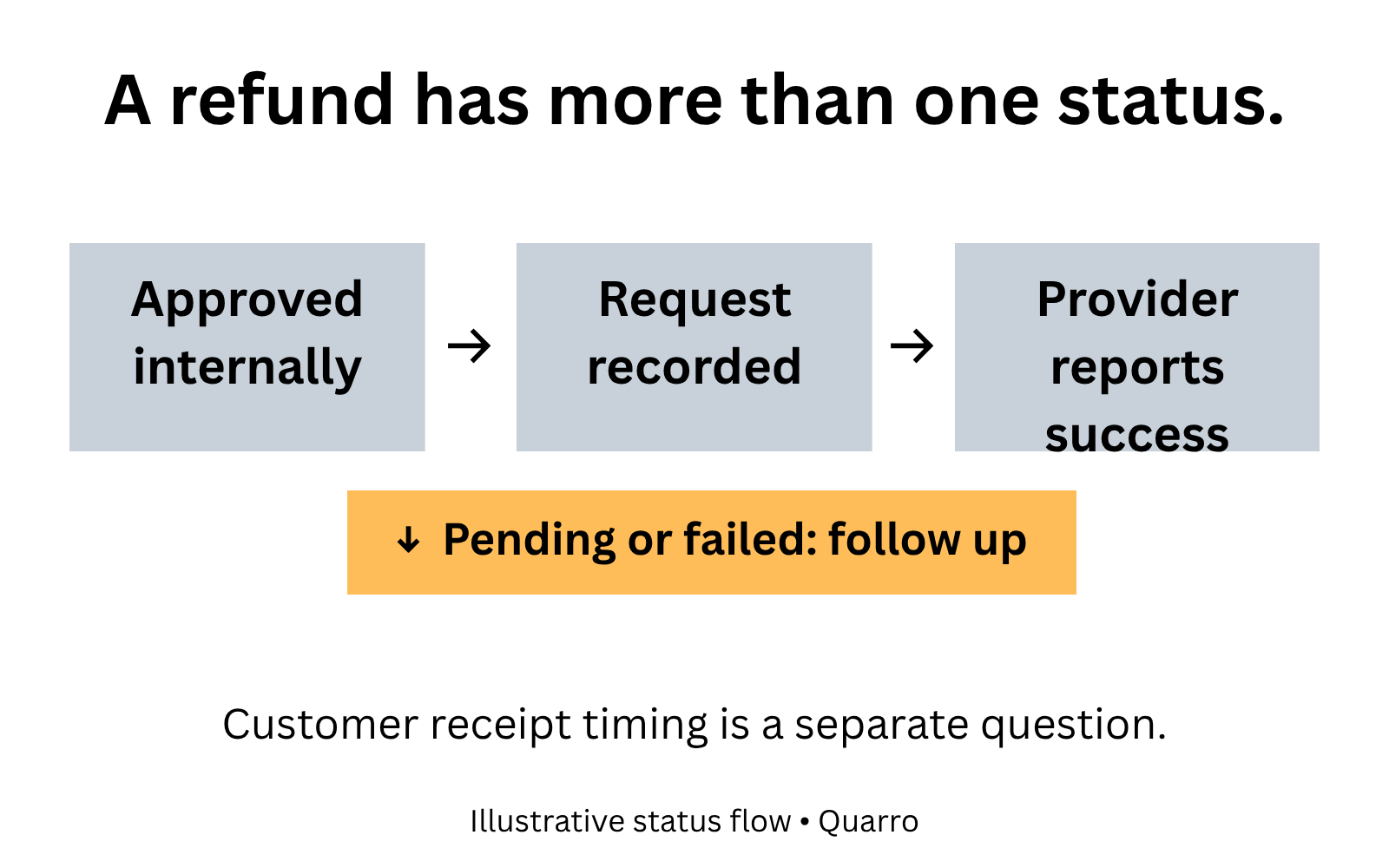
In this illustrative scenario, the team has compressed several events into one label: approval, submission and outcome. A better support view gives each event a place without asking agents to interpret raw payment-system logs.
This article proposes an operational record and handoff. It does not decide refund entitlement, prescribe accounting treatment or guarantee when a customer receives funds.
Name the evidence behind each status
Internal approval establishes what the business authorized. A recorded provider request establishes which operation was sent or accepted. A provider-reported outcome describes what the payment system says happened. Customer receipt is a further question that should not be inferred from a button click.
Stripe's refund documentation provides a concrete reason for keeping these distinctions: card refunds may remain pending when the available balance is insufficient, and refunds can fail. Other payment methods and providers have their own behavior. Those details support checking the actual outcome rather than designing a universal immediate-success state.
Use customer-facing language that matches the evidence. “Request recorded; awaiting provider outcome” is different from “Refund completed.” Do not manufacture an expected date when the available record cannot support one.
Build a case record an agent can follow
A proposed case view can retain the order reference, original payment reference, approved amount and currency, authorization record, provider refund reference and most recent verified status. Keep timestamps for approval, submission and the latest status observation. A source reference helps distinguish fresh evidence from an old note.
For a partial refund, identify the particular operation rather than attaching every update only to the order. Stripe's create-refund reference allows partial refunds up to the remaining unrefunded amount. That API rule does not replace the business's own authorization checks or establish that a second request is appropriate.
An uncertain submission needs investigation. If the interface timed out, inspect the provider record before creating another operation. The support record should make that uncertainty visible instead of presenting either a success tick or an invitation to press the button repeatedly.
Assign follow-up to unresolved outcomes
For illustrative case R-17, suppose approval exists and a provider reference has been recorded, but the latest status is pending. The next action is to review the unresolved operation under the team's procedure, not to mark the customer question answered indefinitely.
Give pending, failed and unknown states an owner and a review point. A failed request may need a different authorized resolution, but the software should not improvise that resolution. Record what was communicated to the customer and the evidence used.
Separate closing an agent's immediate task from declaring the refund journey complete. A handoff can be finished while another named team still owns follow-up. If the system permits that distinction, both queues should show it clearly.
Test the uncomfortable states before launch
Use the provider's supported test environment and synthetic cases, without moving real money. Check an ordinary success, pending outcome, failure, partial refund and uncertain submission. Verify that each produces accurate language and the intended owner.
Also test a late status update after the first agent has handed off the case. The update must reach the current owner rather than disappearing into a closed queue. Restrict access to payment details and keep unnecessary sensitive information out of notes.
This adds some state management and support work. Keep the first version narrow: one payment provider, one refund journey and one escalation path. The useful deliverable is an answerable question—what evidence do we have for this specific refund now?